
Social factors in the business environment refer to the demographic, cultural, behavioral, and societal forces that influence how a business operates, markets its products, and connects with its customers. These forces sit outside any individual company's control — yet they determine the size of markets, shape consumer expectations, and define what a brand must stand for to succeed.
Core Definition
Social factors are external conditions — including population demographics, cultural norms, lifestyle trends, education levels, health consciousness, and digital communication habits — that directly affect business demand, workforce dynamics, and brand strategy. They form the "S" in the widely used PESTLE analysis framework.
Unlike economic factors (which measure financial conditions) or political factors (which reflect regulatory environments), social factors are inherently human. They reflect how people live, what they believe, what they aspire to, and how quickly their expectations change. A business that fails to monitor its social environment is essentially flying blind into its own market.
The concept gained significant academic grounding through the work of management scholars like Michael Porter, whose competitive forces framework acknowledges that buyer behavior — fundamentally a social phenomenon — is a primary driver of industry profitability. More recently, the global consulting firm McKinsey has identified sociocultural alignment as one of the top five predictors of long-term brand resilience.
Why Social Factors Matter for Business Strategy
Ignoring social factors is one of the most consistent strategic mistakes in business. A technically superior product designed without social awareness can fail completely, while an average product that resonates with the social moment of its audience can become a cultural phenomenon.
Consider Kodak: the company did not fail because of poor engineering or weak finances — it failed because it did not respond to the social shift toward digital self-expression. People wanted to share moments instantly with friends, not develop film rolls. That was a social factor, not a technology problem.
"Companies that embed sociocultural intelligence into their strategy — not just as a marketing exercise but as a core input to decision-making — consistently outperform peers across sectors."
— McKinsey Global Institute, The State of Consumer Sentiment, 2024
Social factors matter across every business function: marketing (how you communicate), product (what you build), HR (who you hire and how you retain them), operations (where and how you work), and corporate strategy (which markets you enter and exit).
Key Statistics: The Real Business Impact of Social Factors
The numbers make the importance of social factors undeniable. Across global markets, societal forces are reshaping consumer behavior, workforce dynamics, and industry structures at an accelerating pace.
64% of consumers say cultural and social identity influences their purchasing decisions
Source: Deloitte Global Consumer Survey, 2024
$2.5T in annual consumer spending influenced by health-consciousness trends globally
Source: Global Wellness Institute, 2024
59% of global employees are "quietly quitting," driven largely by shifting social work values
Source: Gallup State of the Global Workplace, 2023
4.9B global social media users in 2025 — shaping brand reputation and consumer opinion in real time
Source: DataReportal Digital 2025 Report
These statistics are not abstract — they represent real decisions consumers and employees make every day. The businesses that track and respond to these signals gain durable competitive advantages. Those that do not find themselves repeatedly surprised by market shifts that were, in retrospect, entirely predictable.
Read also: Business Strategies For Social Impact: A 2026 Guide
The 8 Key Social Factors in the Business Environment
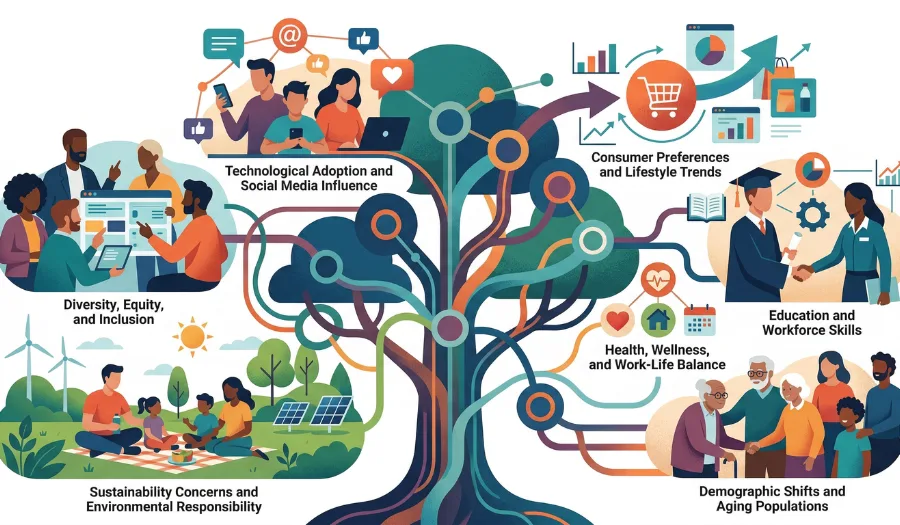
Social factors are diverse and interconnected, but they can be grouped into eight primary categories. Understanding each — and recognizing how they interact — gives businesses a complete picture of their social operating environment.
Demographics and Population Structure
Demographics are the most measurable social factor. Age distribution, population growth rates, urbanization, gender ratios, household size, and income distribution all determine the fundamental shape of a market.
Japan's rapidly ageing population — with over 29% of citizens above 65 (World Bank, 2024) — has created one of the world's largest markets for healthcare robotics, elder care services, and mobility solutions. Conversely, sub-Saharan Africa's median age of 18 makes it the fastest-growing market for mobile-first consumer technology, education platforms, and affordable nutrition products.
Businesses entering new geographies must build their entire go-to-market strategy around demographic realities — product pricing, distribution channels, messaging tone, and feature priorities all follow demographic data.
Cultural Values and Norms
Culture defines what is acceptable, aspirational, and taboo. It shapes how consumers interpret advertising, what they expect from brands, how they negotiate, and what they consider fair treatment. Cross-cultural failures are among the most expensive mistakes in global business.
Geert Hofstede's landmark cultural dimensions research — spanning 76 countries — established that cultures vary predictably along axes of individualism vs. collectivism, uncertainty avoidance, power distance, and long-term orientation. Brands entering new markets without accounting for these dimensions routinely misfire. Walmart's failed entry into Germany, widely studied in business schools, was driven largely by cultural misalignment: its American high-energy store culture felt intrusive to German shoppers who valued quiet, autonomous shopping experiences.
Lifestyle Trends and Consumer Behavior
Lifestyle trends reflect how people choose to spend their time, money, and attention. These trends directly create and destroy product categories. The global health and wellness market reached $5.6 trillion in 2024 (Global Wellness Institute), fueled entirely by a social shift in how people prioritize physical and mental health.
In the food industry, plant-based proteins grew from a niche dietary choice to a $29.4 billion global market (Bloomberg Intelligence, 2024) in under a decade — driven not by technology or government policy, but by a social shift in attitudes toward animal welfare, environmental impact, and personal health.
Businesses that identify lifestyle trends early — before they reach mainstream — can establish category leadership that is very difficult for later entrants to displace.
Education and Skill Levels
The educational profile of a society shapes both the labor market and consumer sophistication simultaneously. A highly educated consumer base demands transparency, evidence-based marketing, and product quality — making superficial brand positioning less effective.
For businesses, education levels also determine the available talent pool. Countries with strong STEM education systems attract technology investment. The World Economic Forum projects that 85 million jobs may be displaced by automation by 2025, while 97 million new roles requiring digital literacy will emerge — making the educational social factor a direct driver of business operational costs and competitive capability.
Social Mobility and Class Structure
The distribution of wealth and the ease of moving between economic classes shapes spending patterns, aspirational brand behavior, and market segmentation strategy. Growing middle classes in markets like India, Vietnam, Indonesia, and Nigeria represent the most significant consumer market expansion opportunity of the current decade.
According to the Brookings Institution, the global middle class is projected to reach 5.6 billion people by 2030 — with 88% of growth occurring in Asia. This social shift is already reshaping luxury goods, consumer electronics, and travel sectors far more rapidly than any single market event.
Health Consciousness and Wellbeing
Post-pandemic, health awareness has become a dominant social force globally. Consumers are more focused on physical health, mental wellbeing, food safety, air quality, and work-life balance than at any prior point in modern history. This is not a temporary trend — longitudinal survey data from Ipsos (2024) shows that health awareness scores among consumers aged 18–45 have risen consistently for seven consecutive years.
Business implications span multiple sectors simultaneously: food companies reformulating products to remove additives, employers expanding mental health coverage to compete for talent, telehealth platforms growing from novelty to essential healthcare infrastructure, and real estate developers making air filtration and wellness amenities standard features rather than premium upgrades.
Attitudes Toward Work and Career
Social attitudes toward employment, purpose, and organizational loyalty vary significantly across generations and geographies — and have shifted dramatically since 2020. Younger generations globally increasingly prioritize flexibility, purpose alignment, and psychological safety over compensation and title.
Gallup's 2024 research found that only 23% of global employees report being actively engaged at work. The remaining 77% — either passively present or actively disengaged — represent an enormous hidden cost. For businesses, this social shift demands genuine investment in culture, not just perks: employees distinguish authentic purpose from performative engagement with increasing sophistication.
Social Media and Digital Communication Culture
With 4.9 billion social media users globally (Data Reportal, 2026), the way people communicate, consume information, form opinions, and make purchasing decisions has been permanently and irreversibly transformed. Social platforms are now the primary discovery mechanism for products, the primary battleground for brand reputation, and the primary community space for consumer identity formation.
This creates both opportunity and risk. A brand aligned with its audience's values can achieve explosive organic growth through community advocacy — the kind of growth that cannot be bought. But a single credible accusation, viral criticism, or cultural misalignment can trigger a reputational crisis that takes years to repair. The social media factor requires businesses to maintain genuine alignment between stated values and actual behavior — because the social scrutiny is now continuous and global.
Social Factors in PESTLE Analysis
PESTLE analysis is one of the most widely used strategic frameworks in business education and practice, used by companies from early-stage startups to Fortune 500 corporations. Social factors (the "S") interact with every other dimension of the framework, often acting as the human trigger that eventually becomes a political, economic, or regulatory force.
|
PESTLE Factor |
Focus Area |
Business Influence |
|
P — Political |
Government policy, trade rules, regulations |
Compliance costs, market access, operational risk |
|
E — Economic |
GDP, inflation, interest rates, employment |
Consumer purchasing power, cost of capital |
|
S — Social ★ |
Demographics, culture, lifestyle, values |
Consumer demand, workforce behavior, brand positioning |
|
T — Technological |
Automation, AI, digital infrastructure |
Operational efficiency, product innovation, disruption risk |
|
L — Legal |
Employment law, data protection, IP rights |
Compliance requirements, liability exposure |
|
E — Environmental |
Climate change, sustainability, resource scarcity |
Supply chain risk, ESG investment pressure |
A critical insight for strategists: social factors frequently precede the other PESTLE forces. Environmental consciousness begins as a social movement before it becomes environmental legislation. Remote work begins as a social preference before it reshapes commercial real estate economics. Understanding social factors early gives businesses time to adapt before the other forces compound.
MR
"The S in PESTLE is the one most executives underinvest in. You can model GDP and interest rates with precision — but social forces move quietly, build slowly, and then shift markets overnight. The businesses that watch them win."
— Dr. Meera Rao, Professor of Strategic Management, London Business School · Author of The Sociological Corporation (2023)
Case Study: Remote Work as a Social Factor That Reshaped Multiple Industries

The most powerful recent demonstration of a social factor's business impact is the global normalization of remote and hybrid work. This was not caused by a law, a technology, or an economic policy — it was a social shift in attitudes toward physical presence, work-life boundaries, and professional identity.
The Remote Work Social Shift: Industry-Wide Consequences
When COVID-19 forced mass working from home in 2020, it did not create the desire for remote work — it revealed it. A Pew Research Center survey (2023) found that 46% of U.S. remote workers say they would quit their jobs if remote work was eliminated. This is a social attitude, not a contractual obligation.
The downstream business consequences were enormous and simultaneous across multiple industries — none of which controlled the social factor that caused them:
Commercial real estate vacancy rates in major global cities hit multi-decade highs. Demand for home office furniture surged — Herman Miller's revenue grew 14% in 2021 driven primarily by home desk and chair sales. Cloud infrastructure investment accelerated by three to five years. Broadband providers saw subscriber growth that had been projected to take a decade arrive in 18 months. Suburban and rural housing markets in the UK, US, and Australia boomed as proximity to offices stopped being a constraint.
Commercial Real Estate ↓Cloud Infrastructure ↑Home Office Products ↑Urban Food & Hospitality ↓Suburban Housing ↑Corporate Culture Costs ↑
This case study demonstrates the central truth about social factors: they are not background context. They are primary forces that simultaneously create winners and losers across entire economic sectors — often faster than businesses can respond.
How Businesses Should Respond to Social Factors
Awareness of social factors is only valuable if it drives action. Here is a proven, practical framework for building social intelligence into business strategy:
-
Conduct regular social environment audits. Dedicate quarterly time to reviewing demographic shifts, cultural movements, and consumer sentiment in your target markets. Use tools like Google Trends, social listening platforms (Brandwatch, Sprout Social), government demographic data, and Statista industry reports.
-
Build a diverse, representative leadership team. Organizations that demographically and culturally reflect their markets make better social judgments — not as a political statement, but as a strategic capability. A team of identical backgrounds has identical blind spots.
-
Embed social signals in product development cycles. Before every major product decision, run a "social fit" check: does this product resonate with the cultural moment of our target audience? Does it respect their values? Will it age well as social attitudes evolve?
-
Align communication with authentic values — not trends. Consumers in 2025 are highly skilled at detecting performative social positioning. Brands that chase social trends without genuine internal alignment face credibility crises. Brands that lead from genuine values build durable loyalty.
-
Monitor ahead of the mainstream. The businesses that profit most from social shifts are the ones that identify them in early adopter communities — Reddit forums, academic sociology research, niche social platforms — before they reach mass market awareness. By the time a social trend appears in mainstream media, the strategic window for early-mover advantage is largely closed.
-
Build organizational agility. Social environments shift faster than ever. The ability to pivot marketing positioning, product features, or operational practices in response to social change is itself a competitive capability. Rigid organizations optimize for a social moment that has already passed.
Frequently Asked Questions
What are social factors in the business environment?
Social factors in the business environment are the demographic, cultural, behavioral, and societal forces that influence how a business operates, markets its products, and serves its customers. These include population demographics, cultural norms, lifestyle trends, education levels, health consciousness, social mobility, attitudes toward work, and digital communication culture. They form the "S" in PESTLE analysis and represent some of the highest-impact external forces on business performance.
What are the 8 key social factors affecting business?
The 8 key social factors are: (1) Demographics and population structure, (2) Cultural values and norms, (3) Lifestyle trends and consumer behavior, (4) Education and skill levels, (5) Social mobility and class structure, (6) Health consciousness and wellbeing, (7) Attitudes toward work and career, and (8) Social media and digital communication culture. Each factor influences different aspects of business strategy — from product design to marketing to workforce management.
How do social factors affect business strategy?
Social factors affect business strategy by shaping consumer demand, workforce expectations, marketing communication, product design, and market entry decisions. According to Deloitte's 2024 Global Consumer Survey, 64% of consumers say their purchasing decisions are influenced by cultural and social identity factors. Businesses that align their strategy with evolving social values consistently outperform competitors in long-term revenue growth and brand resilience.
What is the difference between social and cultural factors in business?
Cultural factors are a subset of social factors. Culture refers specifically to the shared beliefs, traditions, languages, and values of a group, while social factors also encompass broader forces like demographics, class structure, education levels, and lifestyle trends. In simple terms: all cultural factors are social factors, but not all social factors are cultural. When conducting a PESTLE analysis, both must be considered together as part of the "S" dimension.
Why are social factors important in PESTLE analysis?
Social factors are the most human element of PESTLE analysis. They explain consumer behavior from the inside — not just what people buy, but why they buy it, what they believe, and how they see themselves. Critically, social factors often precede other PESTLE forces: a social movement around environmental consciousness becomes environmental regulation; a social preference for remote work reshapes economic patterns in real estate and technology. Understanding social factors early gives businesses strategic foresight.
Can social factors affect a company's HR and recruitment strategy?
Yes — social factors are among the most powerful forces shaping HR and recruitment. Changing social attitudes toward work-life balance, psychological safety, purpose-driven careers, and workplace flexibility have fundamentally altered how businesses must attract and retain talent. Gallup's 2024 research found that only 23% of global employees are actively engaged at work — a figure driven largely by a social mismatch between what employees expect from work and what most organizations currently deliver.
How do social factors affect marketing?
Social factors shape every dimension of marketing strategy. They determine the language, values, imagery, and channels that resonate with a target audience. A brand targeting health-conscious Millennials must communicate differently — and on different platforms — than one targeting cost-focused Baby Boomers. Social media culture (4.9 billion users globally) has also shifted marketing from one-way broadcasting to community-building, requiring brands to earn ongoing trust rather than simply purchase attention.
Conclusion
Social factors in the business environment are not background noise — they are the primary signal. Demographics determine your market. Culture determines your brand. Lifestyle trends determine your product roadmap. Education shapes your workforce. Health consciousness reshapes entire industries. Attitudes toward work redefine your employer brand. And digital social culture gives consumers a megaphone that reaches billions instantly.
The businesses that build genuine social intelligence — not as a marketing exercise but as a core strategic capability — consistently outperform competitors over five-to-ten year horizons. Social environments shift; the question is always whether your business is positioned to benefit from that shift or disrupted by it.
For a complete strategic analysis, combine your social factor review with our guides on PESTLE analysis, economic factors in business, and SWOT analysis framework.