
When Dropbox launched in 2008 with virtually no advertising budget, they used a single referral-driven video to generate 70,000 signups overnight. They didn't know it at the time, but they were running a textbook lean startup social strategy test a hypothesis, measure the response, and iterate fast. Fast forward to 2026, and this approach is no longer a scrappy workaround. It's the competitive advantage every USA startup needs to survive a crowded digital landscape.
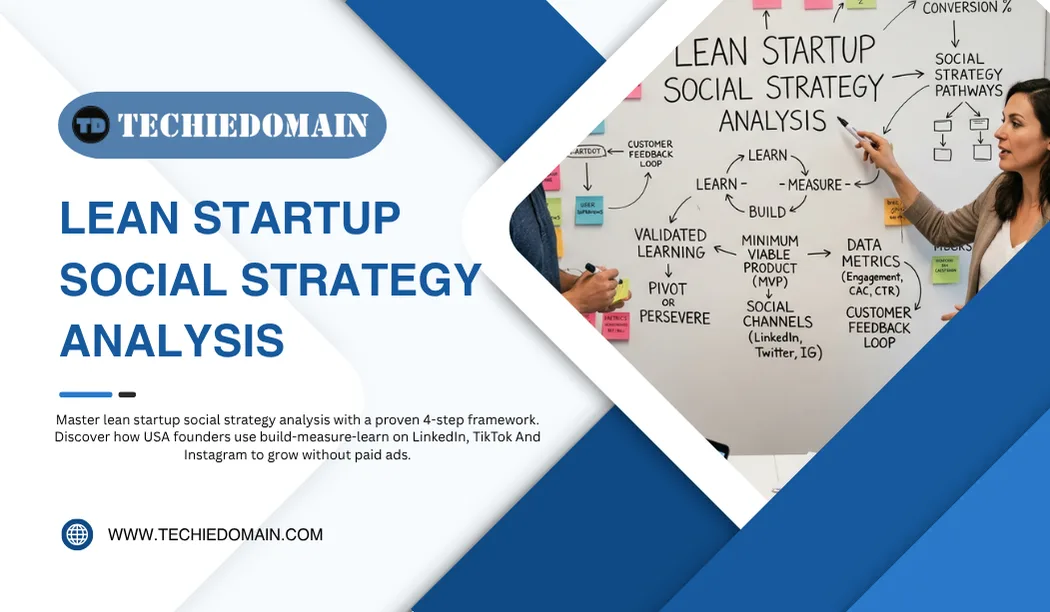
Lean startup social strategy analysis is the process of applying lean methodology principles — specifically the build-measure-learn loop — to your social media marketing efforts. Instead of launching a six-month content calendar and hoping it works, you test small, analyze fast, and pivot where the data points. This guide breaks down exactly how to do it, why it works for the US market, and what tools and frameworks give you the highest ROI in 2026.
The Core Principles of Lean Startup Methodology
Eric Ries introduced the lean startup framework in his 2011 book The Lean Startup, drawing on lessons from Toyota's manufacturing philosophy and Steve Blank's customer development model. The framework rests on three pillars:
- Build — create the smallest possible version of your idea (a Minimum Viable Product, or MVP)
- Measure — gather real data on how users respond
- Learn — use that data to decide whether to persevere or pivot
Most founders apply this to product development. The breakthrough insight for 2026 is that social media is the fastest build-measure-learn laboratory available to any startup. A single LinkedIn post costs nothing and returns audience data within 24 hours. An Instagram Reel can validate a product concept before a single line of code is written. For cash-constrained founders in the USA, this is not a strategy — it's a survival skill.
The lean methodology also demands what Ries calls "validated learning" — the idea that every action must be tied to a hypothesis and measured against a clear metric. In social strategy terms, this means never posting just to post. Every piece of content is an experiment with a question behind it.
How Social Media Fits the Lean Startup Model

Social media is the perfect vehicle for lean startup principles because it delivers fast feedback at near-zero cost. Here's how each major platform maps to the lean framework for USA-based startups in 2026:
LinkedIn remains the highest-intent platform for B2B startups. Founders building SaaS, consulting, or professional services can run content experiments with text posts, carousels, and short videos. Engagement data (comments over likes) is the most valuable signal for measuring genuine interest versus passive scrolling.
Instagram and TikTok are MVP validation tools for consumer-facing products. A 30-second TikTok showing a product prototype can generate comments that serve as free customer discovery sessions. The US algorithm on both platforms still rewards novelty and early engagement — ideal for first-mover lean testing.
Threads and X (formerly Twitter) are where early-adopter audiences live in 2026. For tech and startup founders, Threads has grown into a genuine community layer. Short takes, polls, and question posts give fast, qualitative feedback — the kind that helps you shape your narrative before you invest in formal content production.
YouTube Shorts rounds out the platform stack. Shorts indexed by Google in 2026 carry significant SEO weight, making them both a social proof tactic and a search visibility asset simultaneously.
The key lean principle here is single-variable testing: when you post across these platforms, change one element at a time — the hook, the format, the call to action — so you know exactly what drove results.
The Lean Social Strategy Analysis Framework: A 4-Step Process
This is the operational core of lean startup social strategy analysis. Follow these four steps and you move from random content posting to a structured growth engine.
Step 1 — Define your social MVP hypothesis
Before creating any content, write a one-sentence hypothesis: "If I post [content type] about [topic] on [platform], then [target audience] will [desired action] because [reason]." This isn't fluffy — it forces clarity and gives you a success metric before you start. Example: "If I post a 60-second LinkedIn video explaining our SaaS pricing model, then early-stage founders will comment with pricing questions because they're confused about value-based vs. seat-based pricing."
Step 2 — Build the minimum viable content (MVC)
Minimum viable content is the smallest piece of social content that can test your hypothesis. Not the polished, agency-produced version — the fastest iteration that still communicates clearly. A talking-head video shot on an iPhone, a Canva carousel, a text-only LinkedIn post. The goal is speed to data, not perfection. In 2026, authenticity consistently outperforms production value on every major US platform.
Step 3 — Measure with the right metrics
Vanity metrics (follower count, impressions) tell you almost nothing in a lean framework. The metrics that matter are:
- Comments — qualitative signal of resonance and confusion
- Saves/bookmarks — intent to return; indicates high perceived value
- Click-through rate — conversion from social to your owned channel
- DMs and replies — direct customer discovery, invaluable at early stage
- Share rate — the strongest organic reach signal in 2026 across all platforms
Benchmark these against your hypothesis metric. If the hypothesis said "comments," measure comments — not impressions.
Step 4 — Learn, iterate, and decide to persevere or pivot
After 5–10 content experiments, you have a data set. Look for patterns: Which topics drove comments? Which formats got shares? Which hooks drove clicks? This is your social strategy pivot decision point. If a format is underperforming after genuine testing, pivot — change the platform, the format, or the core message. If something works, double down and systematize it. The lean founder's rule: don't scale what you haven't validated.
Real-World Case Studies: Lean Startups That Won on Social Media

Notion (USA) — Notion spent years with almost no paid social budget, relying instead on power-user communities on Twitter (now X) and Reddit. They let advocates post templates and tutorials organically, measured which use cases drove the most engagement, and leaned into those verticals — students, startups, and developers. The result was a product-community flywheel built on pure lean social principles.
Glossier (USA) — Glossier founder Emily Weiss started Into The Gloss as a blog and social experiment before building a product line. Every Instagram post was a test of what her audience actually wanted. By the time Glossier launched, they had a validated social strategy backed by years of audience data. Their 2026 playbook still reflects that hypothesis-first culture.
Duolingo (USA) — Duolingo's TikTok strategy is the most cited lean social case study of the 2020s. They tested absurdist, character-driven content against traditional educational posts, measured engagement rates, and pivoted entirely toward humor. The result was 14+ million TikTok followers built on a strategy that began as an experiment, not a master plan.
Each of these brands proves that the build-measure-learn cycle applies to content just as powerfully as to product.
Tools and Metrics to Measure Your Lean Social Strategy
The right tools make your analysis loop faster. Here's the 2026 stack for lean USA startups:
Native analytics first — Every platform (LinkedIn Analytics, Instagram Insights, TikTok Analytics) gives you free data that's more accurate than third-party tools for early-stage testing. Start here before paying for anything.
Sprout Social or Hootsuite — For founders managing multiple platforms, these scheduling and analytics tools consolidate your data and allow side-by-side content performance comparisons. Both have USA-based startup plans in 2026.
Google Analytics 4 (GA4) — Track what happens after someone clicks from social to your website. GA4's traffic source reports show which platforms are delivering not just traffic, but converting visitors. This closes the loop between social content and business outcomes.
Notion or Airtable as a content experiment tracker — Build a simple table: hypothesis, platform, post date, key metric, result, decision. This is your lean social lab notebook. Over time, it becomes the most valuable strategic document in your company.
Key KPIs to track weekly: engagement rate by format, comment-to-impression ratio, click-through rate by platform, follower growth rate (directional only), and content-to-lead conversion rate.
Common Mistakes and How to Pivot Fast
Even lean-minded founders make predictable social strategy errors. The most common ones in the US market in 2026:
Scaling before validating. Hiring a content agency or running paid social before you know what message resonates is the opposite of lean. Spend at least 30 days in organic testing mode before any budget goes to ads.
Ignoring qualitative data. Comments and DMs are richer signals than any analytics dashboard. A post with 12 comments asking the same question is customer discovery gold — it tells you exactly what your audience doesn't understand or desperately wants.
Testing too many variables at once. Changing the platform, the topic, and the format simultaneously means you can't isolate what worked. Change one variable per experiment cycle.
Abandoning a strategy too early. Lean doesn't mean impulsive. Give each hypothesis at least 5–7 content pieces before calling it a pivot. Algorithms take time to distribute content; one underperforming post is data noise, not a trend.
The pivot signal to watch for: if your core metric (comments, saves, clicks) shows no improvement after 10+ experiments across multiple formats, you likely have a message problem — not a content problem. Go back to customer discovery and reframe your value proposition.
Conclusion
Lean startup social strategy analysis is not a content hack. It's a systematic, hypothesis-driven approach to finding what your audience actually responds to — before you waste budget, time, or momentum on the wrong message. For USA founders in 2026, it's the most cost-effective way to build social proof, validate positioning, and grow an audience that converts.
Start with one platform. Write one hypothesis. Build one minimum viable piece of content. Measure the right metric. Learn from the result. Repeat.
That's the whole system.
Frequently Asked Questions
What is lean startup social strategy analysis?
Lean startup social strategy analysis is the practice of applying the build-measure-learn methodology to social media marketing. Instead of committing to a long-term content plan upfront, you run small content experiments, measure performance against a defined hypothesis, and iterate based on real audience data.
How do you measure a lean social media strategy?
Focus on actionable metrics over vanity metrics. Prioritize comments, saves, click-through rates, and DMs over follower counts and impressions. Track results in a simple experiment log tied to each content hypothesis.
What social media platforms work best for lean startups in the USA?
LinkedIn works best for B2B startups; Instagram and TikTok for consumer brands; Threads and X for tech and early-adopter audiences. Start with one platform and validate before expanding.
What is minimum viable content (MVC)?
Minimum viable content is the simplest piece of social content that can test a specific hypothesis. It prioritizes speed and clarity over production quality, allowing founders to gather data faster and make earlier strategic decisions.
How does lean startup methodology apply to social media?
The build-measure-learn loop maps directly: Build = create content; Measure = track key engagement metrics; Learn = decide to persevere with a strategy or pivot based on the data. Every post becomes a structured experiment rather than a random act of marketing.